







In this article
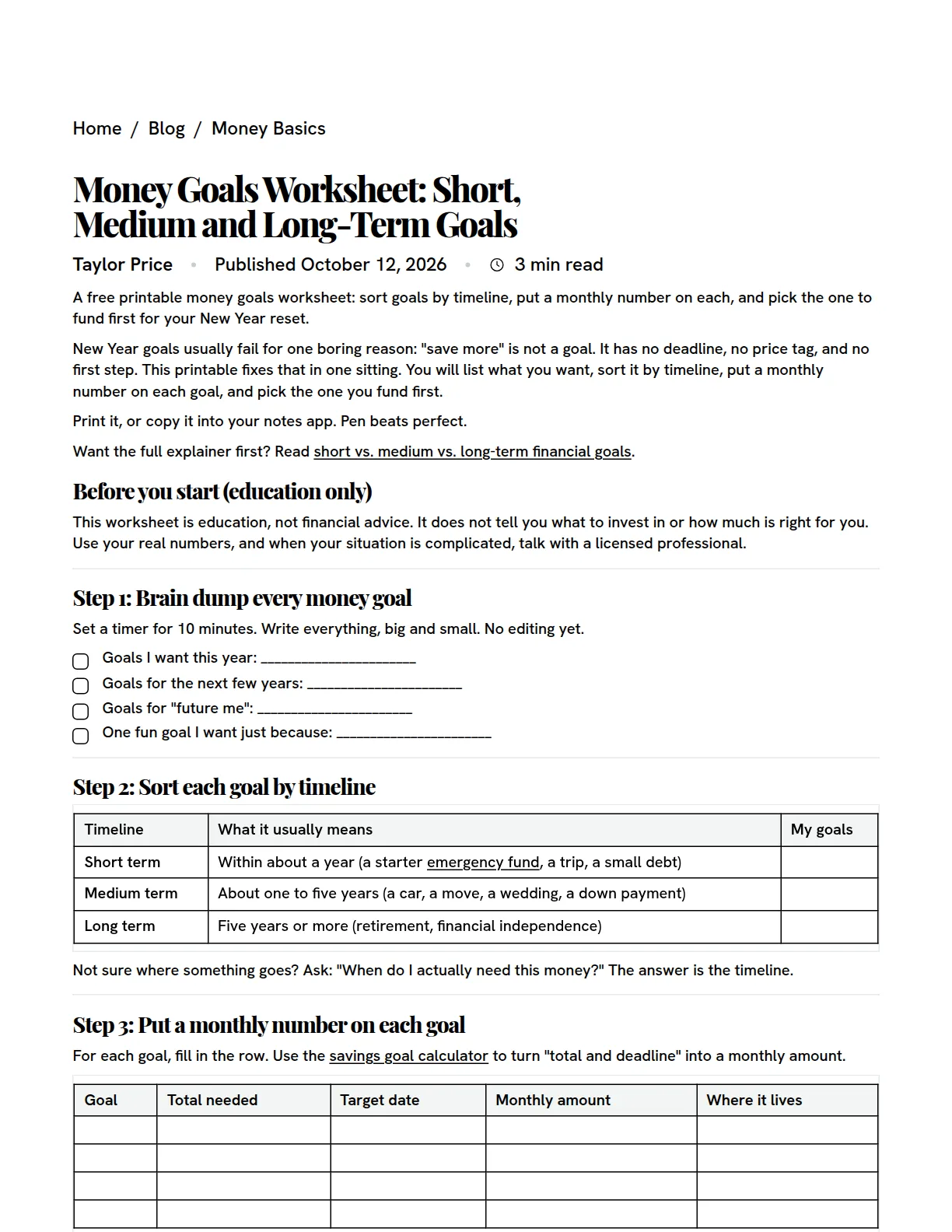
A free printable money goals worksheet: sort goals by timeline, put a monthly number on each, and pick the one to fund first for your New Year reset.
Free printable
Your money goals, on one sheet
Four steps, about 20 minutes, one pen. By the end you have every goal sorted by timeline, a monthly number on each, and the one goal you fund first.
- Brain dump every goal
- Sort by short, medium and long term
- Put a monthly number on each
- Pick the one you fund first
Prefer your phone? Fill it in below. Checked boxes are saved in this browser.
New Year goals usually fail for one boring reason: "save more" isn't a goal. It has no deadline, no price tag, and no first step. This printable fixes that in one sitting. You'll list what you want, sort it by timeline, put a monthly number on each goal, and pick the one you fund first.
Print it, or copy it into your notes app. Pen beats perfect.
Want the full explainer first? Read short vs. medium vs. long-term financial goals.
Money Type lens: This one is for Savers first. You already have money set aside, but it sits in one account with no name and no date, so it never turns into the trip, the move or the investing you keep putting off. The first fix: Put It to Work, and the "Where it lives" column in Step 3 is where that starts. Scramblers should keep it smaller: one short-term goal, a starter buffer, funded after the bills. Find out which one sounds like you with the Money Types quiz.
Before you start (education only)
This worksheet is education, not financial advice. It doesn't tell you what to invest in or how much is right for you. Use your real numbers, and when your situation is complicated, talk with a licensed professional.
Step 1: Brain dump every money goal
Set a timer for 10 minutes. Write everything, big and small. No editing yet.
Step 2: Sort each goal by timeline
| Timeline | What it usually means | My goals |
|---|---|---|
| Short term | Within about a year (a starter emergency fund, a trip, a small debt) | |
| Medium term | About one to five years (a car, a move, a wedding, a down payment) | |
| Long term | Five years or more (retirement, financial independence) |
Not sure where something goes? Ask: "When do I actually need this money?" The answer is the timeline.
Step 3: Put a monthly number on each goal
For each goal, fill in the row. Use the savings goal calculator to turn "total and deadline" into a monthly amount.
| Goal | Total needed | Target date | Monthly amount | Where it lives |
|---|---|---|---|---|
Step 4: Pick the one you fund first
Add up the monthly amounts. If the total is bigger than what you can save, that's normal. You're not failing. You're prioritizing.
Rule of thumb: one goal gets fully funded, the rest get a small amount or wait their turn. Spreading a little across everything is how nothing finishes.
Which goal goes first for your Money Type
- Strategist: A Strategist has a working plan that needs to scale. Pick the next medium-term goal and fund it with your next raise before lifestyle creep finds it.
- Spender: Put one fun goal on the list on purpose. When the fun is funded, the rest of the plan stops feeling like punishment.
- Saver: Your pile needs a job. Give every dollar a goal and a timeline so cash isn't just sitting there.
- Scrambler: One short-term goal only: a starter buffer. Bills first, then the buffer, then everything else.
Not sure which one sounds like you? Take the Money Type quiz to find your lead pattern and your first fix.
Keep it going
Your goals don't need to be perfect. They need a number, a date, and a first move.
How to use it
Twenty minutes, four moves
Dump
Ten-minute timer. Every goal, big and small, fun ones included.Sort
Ask "when do I actually need this money?" That answer is the timeline.Price it
Total, date, monthly amount. The savings goal calculator does the math.Pick one
Fund one goal fully and set it to move on payday.
Worked example
What a filled-in sheet can look like
Say someone lists four goals and can set aside $250 a month right now. Here is what each goal asks for per month.
- Starter emergency fund (short term)$100/mo
$1,000 total in 10 months
- Trip (short term)$100/mo
$1,200 total in 12 months
- Car down payment (medium term)$100/mo
$3,000 total in 30 months
- Retirement investing (long term)$200/mo
A monthly amount into a retirement account
How they could split the $250
- $100 to the starter emergency fund. This is the goal they fund first, fully.
- $100 to retirement investing. Long-term money gets started now, because time is the part you can't buy back later.
- $50 to the trip. A small amount keeps the fun goal alive.
- $0 to the car, on purpose. It waits until the emergency fund is done, then gets that $100.
Curious what a steady monthly amount could grow into? Plug your own numbers into the compound interest calculator.
Common mistakes
Where goal lists usually break

A goal with no number
"Save more" can't be funded. Every line needs a total, a date, and a monthly amount.
Investing money you need soon
Short-term money sits somewhere safe and easy to reach. Investing is for money with time to recover from a drop.
A little bit to everything
Ten goals at $20 each means nothing finishes. One goal gets fully funded first.
Leaving "future me" for later
Long-term goals feel far away, so they get skipped. Even a small monthly amount gives invested money more time to grow.
FAQ
Money goals worksheet questions
- How many money goals should I work on at once?
- Fully fund one goal at a time. The others can get a small amount or wait their turn. When goal one is done, roll its monthly amount into goal two.
- Should I invest the money for my short-term goals?
- Money you need within about a year usually stays somewhere safe and easy to reach, because investments can drop right before you need them. Long-term goals, like retirement, are where investing usually does the heavy lifting. This is education, not advice for your situation.
- What if my monthly total is bigger than what I can save?
- That's normal. It means you're prioritizing, not failing. Pick the goal you fund first, give it its full monthly amount, and pause or shrink the rest on purpose.
- How often should I update my money goals worksheet?
- Check progress on a monthly money date, and redo the whole sheet once a year or when something big changes, like a new job, a move, or a raise.
- Can I use the worksheet without printing it?
- Yes. Fill in the checklist on this page (your checks are saved in this browser) or copy the steps into your notes app. Pen beats perfect either way.
Next steps
Tools that pair with this sheet
 Free toolSavings goal calculator Turn a total and a deadline into a monthly amount.
 Free toolCompound interest calculator See what long-term, invested money could grow into.
 Free toolEmergency fund calculator Size the buffer before anything else.
 Free quizMoney Type quiz Find your pattern and the first fix that keeps goals funded.
 Free quizInvestor type quiz How you handle risk, for the long-term goals you invest for.
 GlossarySinking fund The simple way to stop irregular costs from wrecking a goal.
Want the background first? Read short vs. medium vs. long-term financial goals.
You made it to the end. That's Saver-level patience.